Dividend stocks to grow your portfolio?
For decades, financial advisors, mutual fund salespeople, and investment gurus have preached the same gospel: buying companies that pay dividends is the surest path to building wealth. This advice has become so ingrained in investment culture that many investors automatically equate dividend payments with quality investments. While the appeal is undeniable—who wouldn't want to earn income from their capital while they sleep?—this singular focus on dividend yield can be not just limiting, but potentially dangerous to your long-term wealth building goals.
The Allure of Dividend Investing
The dividend-focused investment strategy is compelling for several psychological and practical reasons. Dividends provide tangible, regular income that investors can see hitting their accounts quarterly. This creates a sense of immediate gratification and progress that can be psychologically satisfying, especially for retirees or those seeking current income. The strategy also appears straightforward: find companies with high dividend yields, buy them, and collect the payments.
Financial professionals often promote dividend investing because it's easy to explain and sell. A 4% dividend yield is a concrete number that clients can understand immediately, unlike more complex metrics like return on invested capital or free cash flow growth rates. This simplicity, however, masks the complexity of what actually drives long-term investment returns.
The Fundamental Flaw in Dividend-Only Thinking
The critical error in dividend-focused investing lies in treating dividend payments as the primary indicator of investment quality, rather than what they actually are: just one possible outcome of a company's capital allocation decisions. A dividend payment tells you very little about the underlying health, growth prospects, or intrinsic value of a business.
Consider this fundamental principle: the main factor that should determine whether a company belongs in a mature portfolio is its ability to generate cash flow, grow revenue, and reinvest in the business for future growth. Whether management chooses to return some of that cash to shareholders through dividends is a secondary consideration that depends on the company's specific circumstances, growth opportunities, and capital allocation philosophy.
When Non-Dividend Payers Outperform
History is replete with examples of non-dividend paying companies that created far more wealth for shareholders than their dividend-paying counterparts. Amazon didn't pay a dividend for the first 25 years of its public existence, yet it generated returns that dwarfed most dividend-focused portfolios. Similarly, Google (Alphabet) and Apple (before it started paying dividends in 2012) created enormous shareholder value through reinvestment and growth rather than quarterly payments.
A company that doesn't pay dividends but consistently reinvests in research and development, expands into new markets, improves operational efficiency, and generates strong cash flow growth can be exponentially more valuable than a company that distributes cash to shareholders while its underlying business deteriorates.
The Hidden Dangers of Dividend Traps
One of the most dangerous aspects of dividend-focused investing is the prevalence of "dividend traps"—companies that maintain high dividend yields precisely because their stock prices have fallen due to fundamental business problems. These companies often find themselves in a vicious cycle: they continue paying dividends to maintain the appearance of financial health and keep income-focused investors from selling, but this depletes cash that should be invested in fixing the underlying business problems.
Even more concerning is the practice of paying dividends funded by debt or through the liquidation of business assets. In these cases, what appears to be dividend income is actually a return of your own capital—you're essentially paying yourself back with your own money, while the underlying value of your investment erodes.
Understanding True Dividend Quality
- Strong and Growing Cash Flows: The dividend should represent only a portion of the company's free cash flow, leaving ample room for reinvestment and providing a margin of safety during economic downturns.
- Reasonable Payout Ratios: Companies that pay out 80-90% of their earnings as dividends have little flexibility to maintain payments during challenging periods or to invest in growth opportunities.
- Business Model Sustainability: The underlying business should have competitive advantages, predictable revenue streams, and the ability to adapt to changing market conditions.
- Management's Capital Allocation Skills: The best dividend-paying companies are those where management can balance returning cash to shareholders with investing in profitable growth opportunities.
A Comprehensive Investment Approach
At BlueSky Investment Counsel, our investment analysis goes far beyond dividend yield. We evaluate multiple factors that truly determine long-term investment success:
- Quality of Management
- Growth Potential and Execution
- Financial Health and Debt Management
- Operational Metrics
- Valuation
- Market Position and Competitive Advantages
- Liquidity and Market Dynamics
The Startup Analogy: When Income Payments Destroy Value
To illustrate the danger of focusing solely on income generation, consider investing in a startup that promises to pay you back a portion of your investment each quarter, regardless of its business performance. Initially, these payments might feel rewarding—you're receiving regular cash flow from your investment. However, if the underlying business isn't growing and generating sufficient cash flow to support these payments, you're essentially receiving your own capital back in installments.
The Difference Between Investing and Trading
Understanding the distinction between investing and trading is crucial for building long-term wealth. Trading focuses on short-term price movements, market sentiment, and technical patterns. Investing involves buying ownership stakes in businesses that you understand and believe will grow in value over time.
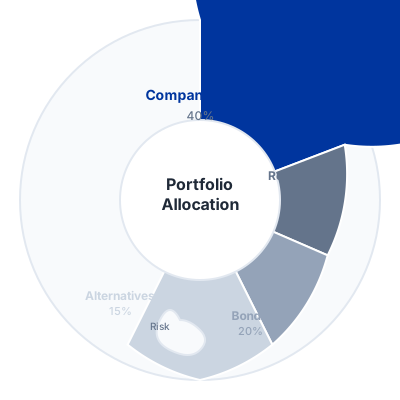
Building a Balanced Portfolio Approach
This doesn't mean dividend-paying stocks have no place in a well-constructed portfolio. High-quality dividend payers can provide stability, current income, and inflation protection—selected via the same rigorous analysis applied to all holdings.
- Growth Companies
- Quality Dividend Payers
- Value Opportunities
- International Exposure
Conclusion: Focus on Business Quality, Not Just Income
The path to long-term wealth creation lies not in chasing the highest dividend yields, but in understanding what you're buying and why you're buying it. The best investments are businesses that can compound intrinsic value over time through sustainable competitive advantages, efficient capital allocation, and strong execution.